



.svg)
.svg)


Navigating Your Facelift Consultation: Essential Insights and Questions
News
/
April 15, 2026
What to Expect During a Facelift Consultation: Key Questions to Ask
Navigating Your Facelift Consultation: Essential Insights and Questions

Body contouring has revolutionized the way we think about self-care and aesthetic transformations. It’s more than just a cosmetic procedure—it’s a path to enhanced confidence and self-expression.
Why a Thorough Consultation Matters
During a facelift consultation the surgeon evaluates the patient’s aesthetic goals, medical background, and facial anatomy to set realistic expectations. By reviewing before‑and‑after photographs of patients with similar structures, the surgeon helps the individual understand what can be achieved and what limits remain, reducing the risk of disappointment. Equally important is verifying the surgeon’s credentials: board certification by the American Board of Plastic Surgery or the American Board of Facial Plastic and Reconstructive Surgery demonstrates rigorous training, while disclosed fellowship experience and high annual facelift volume indicate refined technical skill. The consultation also confirms that the surgical facility is accredited and that the surgeon has appropriate hospital privileges, ensuring a safe environment. Finally, a personalized treatment plan is crafted, selecting the optimal technique (SMAS, deep plane, mini‑lift, etc.) and outlining pre‑, intra‑operative and post‑operative instructions, timing, and cost, thereby aligning the surgeon’s expertise with the patient’s desired outcome.
Preparing for Your First Visit
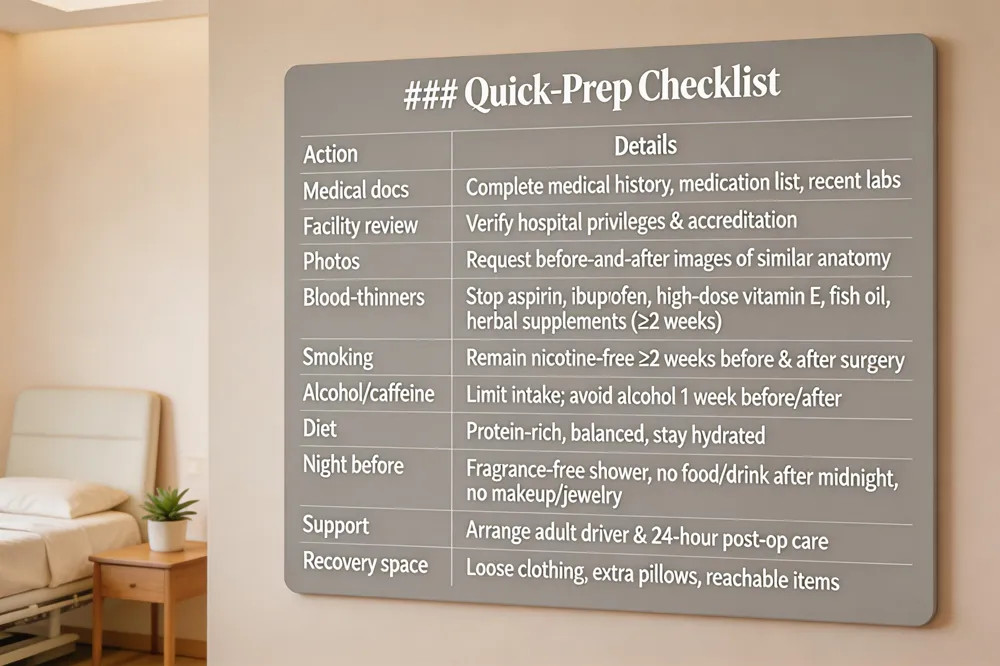 A successful facelift begins with a thorough pre‑consultation preparation. Bring a complete medical history, a list of medications and supplements, and any recent lab results. Review the practice’s hospital privileges and facility accreditation, and request before‑and‑after photos of patients with similar facial anatomy.
What should I do two weeks before a facelift?
Discontinue blood‑thinning agents (aspirin, ibuprofen, high‑dose vitamin E, fish oil) and herbal supplements that increase bleeding. Stop smoking and nicotine products; remain nicotine‑free for at least two weeks before and after surgery. Limit alcohol and caffeine, stay well‑hydrated, and follow a balanced, protein‑rich diet. Ensure all prescribed medications are filled.
What should I avoid before a facelift?
Avoid aspirin, ibuprofen, vitamin E, fish oil, herbal anti‑inflammatories, and any nicotine use at least one month prior. Refrain from alcohol for a week before and after, and steer clear of high‑salt foods. On the night before surgery, fast after midnight and skip makeup, lotions, perfume, and jewelry.
What should I do the night before a facelift?
Shower with a fragrance‑free antibacterial soap, keep the hair clean, and avoid eating or drinking after midnight. Arrange a responsible adult to drive you and stay for 24 hours post‑op. Prepare a recovery space with loose clothing, extra pillows, and easy‑to‑reach items.
What questions should I ask my surgeon before a facelift?
Confirm Board certification (American Board of Plastic Surgery), hospital privileges and facility accreditation. Ask which facelift technique is recommended for your anatomy, see before‑and‑after photos, discuss recovery timeline, pain management, risks, complication plans, and request a detailed cost transparency breakdown.
Should I consider a non‑surgical “Cinderella” facelift before opting for surgery?
A Cinderella lift (threads, Botox, fillers) offers modest, short‑term improvement (12‑18 months) with minimal downtime, suitable for early signs of aging. For pronounced laxity, deep folds, or lasting natural results, a surgical facelift—performed by an experienced facial aesthetic surgeon—provides greater durability and comprehensive rejuvenation. A thorough consultation will help determine the best approach for your goals.
Assessing Candidacy and Safety
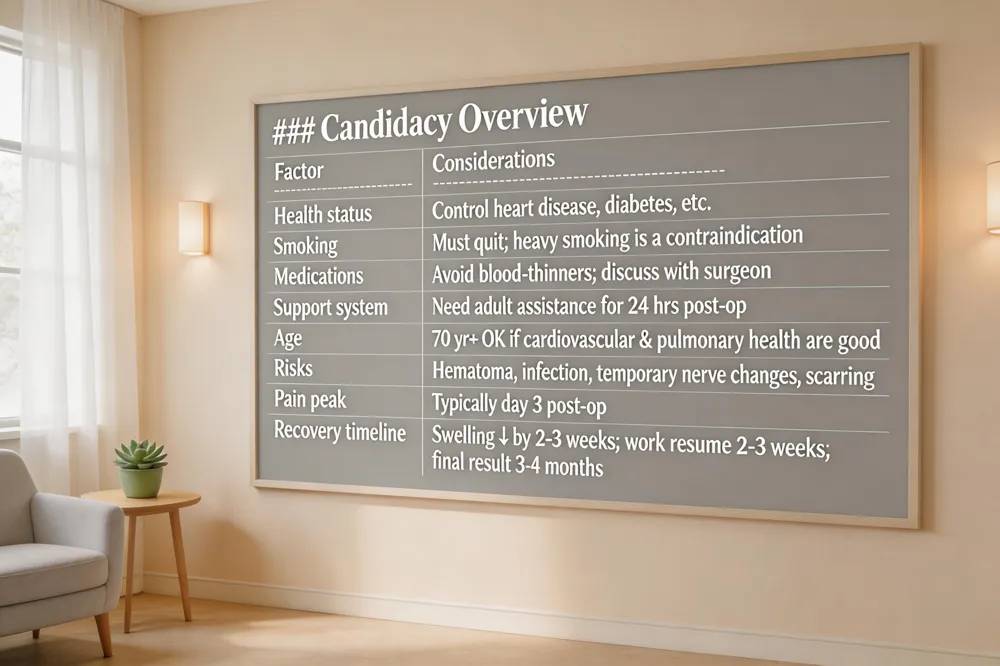 A facelift is generally safe when the patient is in good overall health, has realistic expectations, and can commit to postoperative care. Reasons not to get a facelift include uncontrolled medical conditions (e.g., heart disease, diabetes), heavy smoking, unrealistic body‑image goals, lack of a support system, and use of blood‑thinning medications that increase bleeding risk. Is a facelift safe for a 70‑year‑old patient? Age alone is not a contraindication; safety depends on cardiovascular and pulmonary status, skin quality, and the ability to heal. A thorough pre‑operative evaluation—including medical history, labs, and physical exam—determines eligibility, and modern techniques can minimize anesthesia and surgical risks for well‑conditioned seniors. Common complications are hematoma, infection, temporary facial nerve injury or numbness, scarring, and prolonged swelling; serious events like deep‑vein thrombosis or cardiac issues are rare when performed by a board‑certified surgeon in an accredited facility. Most painful day is typically the third postoperative day, when swelling peaks and a dull ache is most pronounced; pain usually eases after the fourth to fifth day. Normal appearance returns within 2–3 weeks as swelling subsides, with most patients resuming work and social activities; the final aesthetic result settles between 3 and 4 months, with minor residual edema possibly persisting up to a year.
Understanding Surgical Options
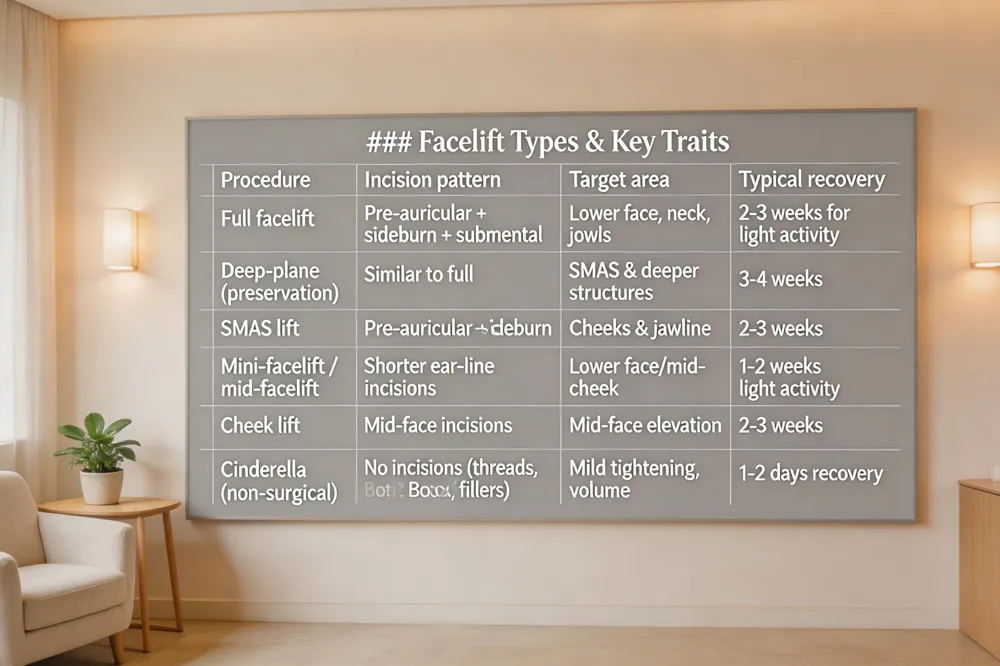 A facelift consultation reviews several surgical options tailored to each patient’s anatomy and goals.
What are the main types of facelift procedures offered? The practice provides a traditional full facelift for comprehensive lower‑face and neck rejuvenation, a deep‑plane (preservation) facelift that lifts structures beneath the SMAS for broader results, and a classic SMAS lift that targets the superficial musculo‑aponeurotic system for cheek and jawline contour with a shorter recovery. For less invasive needs, a mini‑facelift or mid‑facelift uses smaller incisions to address the lower face or mid‑cheek, while cheek lifts focus on mid‑face elevation. Combination approaches may add thread lifts and filler‑based volume restoration.
Where are the incisions for a typical facelift? Incisions are discreetly placed along natural ear and hairline contours: a primary cut behind the ear following the pre‑auricular line, a secondary line along the sideburn/temple area, and often a short submental incision under the chin for neck access. These locations hide scars within hair or ear tissue, minimizing visible scarring.
What is a Cinderella facelift? The Cinderella facelift is a minimally invasive, non‑surgical rejuvenation that blends dissolvable barbed threads for immediate tightening and collagen stimulation with strategic Botox and dermal filler injections. Adjuncts such as microneedling or radio‑frequency may be added. Recovery is rapid—only a few days of mild swelling—and results can last up to two years, offering a natural‑looking alternative to traditional surgery.
Recovery Timeline and Lifestyle Adjustments
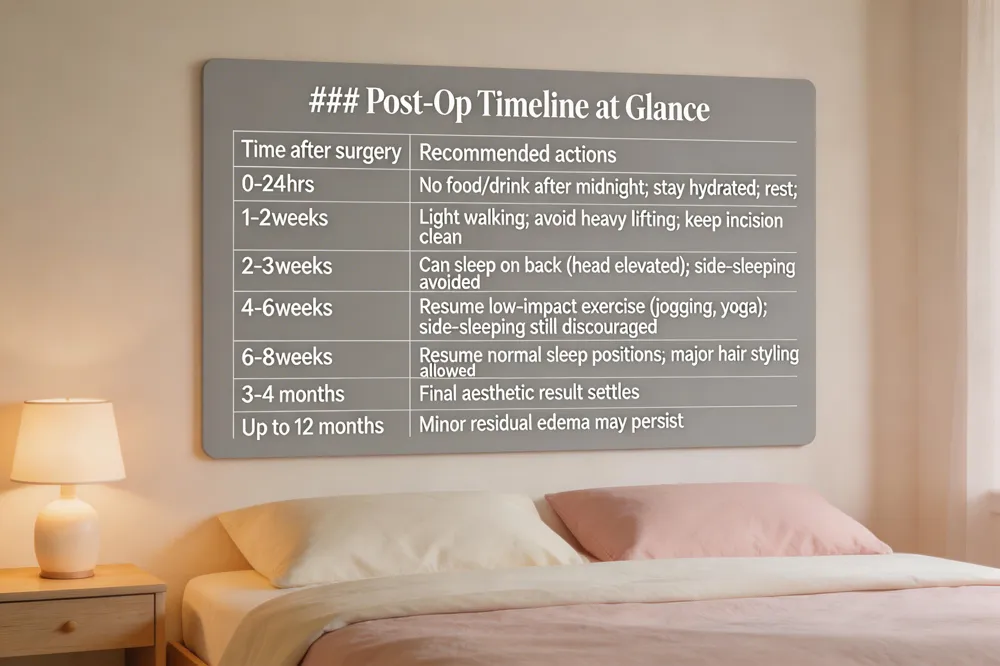 A successful facelift recovery hinges on respecting the surgeon’s timeline for sleep, activity, and grooming.
How long after a facelift can I sleep on my side? Most surgeons, including Dr. Loeb, advise sleeping on your back with the head slightly elevated for at least 2‑3 weeks. Side‑sleeping is generally avoided for 4‑6 weeks to protect incisions and reduce swelling. Once the surgeon confirms that tissues are strong, you may resume side‑sleeping with a firm pillow and slight elevation, but the safest rule is to wait until the 6‑week mark.
Is it normal to be swollen 4 weeks after a facelift? Yes. The bulk of swelling subsides by weeks three to six, yet residual fluid—especially around the jawline and under the chin—can linger for months as collagen remodels. Elevation, hydration, a low‑salt diet, and light activity aid drainage. Contact your surgeon if swelling is painful, red, febrile, or hard, indicating possible infection or hematoma.
How long after a facelift can I resume regular exercise? Light walking can start after 1‑2 weeks. Low‑impact activities such as gentle jogging, yoga, or light stretching are usually safe around 4‑6 weeks, while heavy resistance or high‑intensity cardio should be delayed until at least six weeks.
What is the best haircut after a facelift? A layered, medium‑length lob (just above the shoulders) with soft waves conceals hairline incisions and avoids tension on healed skin. Wait until incisions are fully healed (6‑8 weeks) before major styling, and choose loose, side‑parted looks over tight ponytails or buns.
Financial Considerations and Follow‑Up
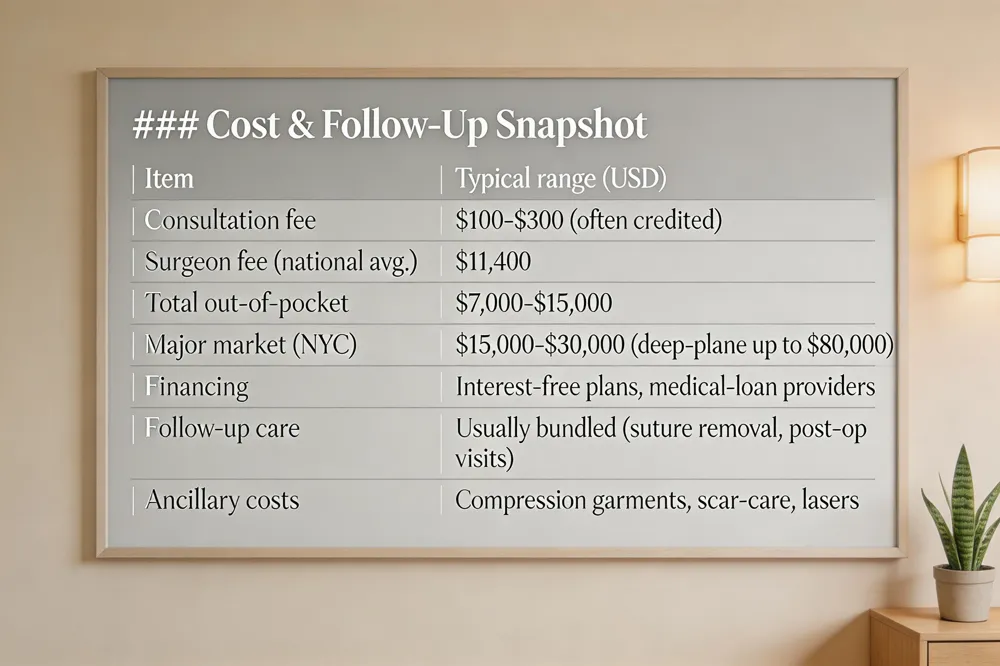 A facelift consultation is often complimentary in boutique, high‑volume practices, but when a fee is charged it typically ranges from $100 to $300 (average $150‑$300). Many offices credit this amount toward the total surgical bill, so it functions as a partial payment rather than a non‑refundable charge.
The national average surgeon fee for a facelift is about $11,400, but total out‑of‑pocket costs—including anesthesia, facility fees, and postoperative care—usually fall between $7,000 and $15,000. In major markets such as New York City, comprehensive facelifts performed by board‑certified surgeons can range from $15,000 to $30,000, with more complex deep‑plane or combined neck procedures reaching $20,000‑$80,000. Insurance generally does not cover cosmetic facelifts, so patients rely on practice‑offered financing, interest‑free payment plans, or third‑party medical‑loan providers.
Follow‑up visits, suture removal, and routine postoperative care are typically bundled into the quoted price, but patients should verify that all ancillary expenses—such as compression garments, scar‑management products, and any adjunctive laser or skin‑care treatments—are included. Transparent cost breakdowns and financing options are essential for informed decision‑making.
Your Next Steps
After reviewing the information, the next step is to schedule a personalized consultation with a qualified facial plastic surgeon. During the visit the surgeon will assess your medical history, skin quality, facial anatomy, and aesthetic goals, then suggest the most suitable facelift technique. Bring a written list of questions—such as board certification, experience with your desired technique, facility accreditation, recovery timeline, and cost—to ensure all concerns are covered. Choosing a surgeon who holds board certification from the American Board of Plastic Surgery or the American Board of Facial Plastic and Reconstructive Surgery guarantees you are in the care of a specialist with rigorous training and proven expertise.
Why a Thorough Consultation Matters
During a facelift consultation the surgeon evaluates the patient’s aesthetic goals, medical background, and facial anatomy to set realistic expectations. By reviewing before‑and‑after photographs of patients with similar structures, the surgeon helps the individual understand what can be achieved and what limits remain, reducing the risk of disappointment. Equally important is verifying the surgeon’s credentials: board certification by the American Board of Plastic Surgery or the American Board of Facial Plastic and Reconstructive Surgery demonstrates rigorous training, while disclosed fellowship experience and high annual facelift volume indicate refined technical skill. The consultation also confirms that the surgical facility is accredited and that the surgeon has appropriate hospital privileges, ensuring a safe environment. Finally, a personalized treatment plan is crafted, selecting the optimal technique (SMAS, deep plane, mini‑lift, etc.) and outlining pre‑, intra‑operative and post‑operative instructions, timing, and cost, thereby aligning the surgeon’s expertise with the patient’s desired outcome.
Preparing for Your First Visit
 A successful facelift begins with a thorough pre‑consultation preparation. Bring a complete medical history, a list of medications and supplements, and any recent lab results. Review the practice’s hospital privileges and facility accreditation, and request before‑and‑after photos of patients with similar facial anatomy.
What should I do two weeks before a facelift?
Discontinue blood‑thinning agents (aspirin, ibuprofen, high‑dose vitamin E, fish oil) and herbal supplements that increase bleeding. Stop smoking and nicotine products; remain nicotine‑free for at least two weeks before and after surgery. Limit alcohol and caffeine, stay well‑hydrated, and follow a balanced, protein‑rich diet. Ensure all prescribed medications are filled.
What should I avoid before a facelift?
Avoid aspirin, ibuprofen, vitamin E, fish oil, herbal anti‑inflammatories, and any nicotine use at least one month prior. Refrain from alcohol for a week before and after, and steer clear of high‑salt foods. On the night before surgery, fast after midnight and skip makeup, lotions, perfume, and jewelry.
What should I do the night before a facelift?
Shower with a fragrance‑free antibacterial soap, keep the hair clean, and avoid eating or drinking after midnight. Arrange a responsible adult to drive you and stay for 24 hours post‑op. Prepare a recovery space with loose clothing, extra pillows, and easy‑to‑reach items.
What questions should I ask my surgeon before a facelift?
Confirm Board certification (American Board of Plastic Surgery), hospital privileges and facility accreditation. Ask which facelift technique is recommended for your anatomy, see before‑and‑after photos, discuss recovery timeline, pain management, risks, complication plans, and request a detailed cost transparency breakdown.
Should I consider a non‑surgical “Cinderella” facelift before opting for surgery?
A Cinderella lift (threads, Botox, fillers) offers modest, short‑term improvement (12‑18 months) with minimal downtime, suitable for early signs of aging. For pronounced laxity, deep folds, or lasting natural results, a surgical facelift—performed by an experienced facial aesthetic surgeon—provides greater durability and comprehensive rejuvenation. A thorough consultation will help determine the best approach for your goals.
Assessing Candidacy and Safety
 A facelift is generally safe when the patient is in good overall health, has realistic expectations, and can commit to postoperative care. Reasons not to get a facelift include uncontrolled medical conditions (e.g., heart disease, diabetes), heavy smoking, unrealistic body‑image goals, lack of a support system, and use of blood‑thinning medications that increase bleeding risk. Is a facelift safe for a 70‑year‑old patient? Age alone is not a contraindication; safety depends on cardiovascular and pulmonary status, skin quality, and the ability to heal. A thorough pre‑operative evaluation—including medical history, labs, and physical exam—determines eligibility, and modern techniques can minimize anesthesia and surgical risks for well‑conditioned seniors. Common complications are hematoma, infection, temporary facial nerve injury or numbness, scarring, and prolonged swelling; serious events like deep‑vein thrombosis or cardiac issues are rare when performed by a board‑certified surgeon in an accredited facility. Most painful day is typically the third postoperative day, when swelling peaks and a dull ache is most pronounced; pain usually eases after the fourth to fifth day. Normal appearance returns within 2–3 weeks as swelling subsides, with most patients resuming work and social activities; the final aesthetic result settles between 3 and 4 months, with minor residual edema possibly persisting up to a year.
Understanding Surgical Options
 A facelift consultation reviews several surgical options tailored to each patient’s anatomy and goals.
What are the main types of facelift procedures offered? The practice provides a traditional full facelift for comprehensive lower‑face and neck rejuvenation, a deep‑plane (preservation) facelift that lifts structures beneath the SMAS for broader results, and a classic SMAS lift that targets the superficial musculo‑aponeurotic system for cheek and jawline contour with a shorter recovery. For less invasive needs, a mini‑facelift or mid‑facelift uses smaller incisions to address the lower face or mid‑cheek, while cheek lifts focus on mid‑face elevation. Combination approaches may add thread lifts and filler‑based volume restoration.
Where are the incisions for a typical facelift? Incisions are discreetly placed along natural ear and hairline contours: a primary cut behind the ear following the pre‑auricular line, a secondary line along the sideburn/temple area, and often a short submental incision under the chin for neck access. These locations hide scars within hair or ear tissue, minimizing visible scarring.
What is a Cinderella facelift? The Cinderella facelift is a minimally invasive, non‑surgical rejuvenation that blends dissolvable barbed threads for immediate tightening and collagen stimulation with strategic Botox and dermal filler injections. Adjuncts such as microneedling or radio‑frequency may be added. Recovery is rapid—only a few days of mild swelling—and results can last up to two years, offering a natural‑looking alternative to traditional surgery.
Recovery Timeline and Lifestyle Adjustments
 A successful facelift recovery hinges on respecting the surgeon’s timeline for sleep, activity, and grooming.
How long after a facelift can I sleep on my side? Most surgeons, including Dr. Loeb, advise sleeping on your back with the head slightly elevated for at least 2‑3 weeks. Side‑sleeping is generally avoided for 4‑6 weeks to protect incisions and reduce swelling. Once the surgeon confirms that tissues are strong, you may resume side‑sleeping with a firm pillow and slight elevation, but the safest rule is to wait until the 6‑week mark.
Is it normal to be swollen 4 weeks after a facelift? Yes. The bulk of swelling subsides by weeks three to six, yet residual fluid—especially around the jawline and under the chin—can linger for months as collagen remodels. Elevation, hydration, a low‑salt diet, and light activity aid drainage. Contact your surgeon if swelling is painful, red, febrile, or hard, indicating possible infection or hematoma.
How long after a facelift can I resume regular exercise? Light walking can start after 1‑2 weeks. Low‑impact activities such as gentle jogging, yoga, or light stretching are usually safe around 4‑6 weeks, while heavy resistance or high‑intensity cardio should be delayed until at least six weeks.
What is the best haircut after a facelift? A layered, medium‑length lob (just above the shoulders) with soft waves conceals hairline incisions and avoids tension on healed skin. Wait until incisions are fully healed (6‑8 weeks) before major styling, and choose loose, side‑parted looks over tight ponytails or buns.
Financial Considerations and Follow‑Up
 A facelift consultation is often complimentary in boutique, high‑volume practices, but when a fee is charged it typically ranges from $100 to $300 (average $150‑$300). Many offices credit this amount toward the total surgical bill, so it functions as a partial payment rather than a non‑refundable charge.
The national average surgeon fee for a facelift is about $11,400, but total out‑of‑pocket costs—including anesthesia, facility fees, and postoperative care—usually fall between $7,000 and $15,000. In major markets such as New York City, comprehensive facelifts performed by board‑certified surgeons can range from $15,000 to $30,000, with more complex deep‑plane or combined neck procedures reaching $20,000‑$80,000. Insurance generally does not cover cosmetic facelifts, so patients rely on practice‑offered financing, interest‑free payment plans, or third‑party medical‑loan providers.
Follow‑up visits, suture removal, and routine postoperative care are typically bundled into the quoted price, but patients should verify that all ancillary expenses—such as compression garments, scar‑management products, and any adjunctive laser or skin‑care treatments—are included. Transparent cost breakdowns and financing options are essential for informed decision‑making.
Your Next Steps
After reviewing the information, the next step is to schedule a personalized consultation with a qualified facial plastic surgeon. During the visit the surgeon will assess your medical history, skin quality, facial anatomy, and aesthetic goals, then suggest the most suitable facelift technique. Bring a written list of questions—such as board certification, experience with your desired technique, facility accreditation, recovery timeline, and cost—to ensure all concerns are covered. Choosing a surgeon who holds board certification from the American Board of Plastic Surgery or the American Board of Facial Plastic and Reconstructive Surgery guarantees you are in the care of a specialist with rigorous training and proven expertise.
Heading
Why a Thorough Consultation Matters
During a facelift consultation the surgeon evaluates the patient’s aesthetic goals, medical background, and facial anatomy to set realistic expectations. By reviewing before‑and‑after photographs of patients with similar structures, the surgeon helps the individual understand what can be achieved and what limits remain, reducing the risk of disappointment. Equally important is verifying the surgeon’s credentials: board certification by the American Board of Plastic Surgery or the American Board of Facial Plastic and Reconstructive Surgery demonstrates rigorous training, while disclosed fellowship experience and high annual facelift volume indicate refined technical skill. The consultation also confirms that the surgical facility is accredited and that the surgeon has appropriate hospital privileges, ensuring a safe environment. Finally, a personalized treatment plan is crafted, selecting the optimal technique (SMAS, deep plane, mini‑lift, etc.) and outlining pre‑, intra‑operative and post‑operative instructions, timing, and cost, thereby aligning the surgeon’s expertise with the patient’s desired outcome.
Preparing for Your First Visit
 A successful facelift begins with a thorough pre‑consultation preparation. Bring a complete medical history, a list of medications and supplements, and any recent lab results. Review the practice’s hospital privileges and facility accreditation, and request before‑and‑after photos of patients with similar facial anatomy.
What should I do two weeks before a facelift?
Discontinue blood‑thinning agents (aspirin, ibuprofen, high‑dose vitamin E, fish oil) and herbal supplements that increase bleeding. Stop smoking and nicotine products; remain nicotine‑free for at least two weeks before and after surgery. Limit alcohol and caffeine, stay well‑hydrated, and follow a balanced, protein‑rich diet. Ensure all prescribed medications are filled.
What should I avoid before a facelift?
Avoid aspirin, ibuprofen, vitamin E, fish oil, herbal anti‑inflammatories, and any nicotine use at least one month prior. Refrain from alcohol for a week before and after, and steer clear of high‑salt foods. On the night before surgery, fast after midnight and skip makeup, lotions, perfume, and jewelry.
What should I do the night before a facelift?
Shower with a fragrance‑free antibacterial soap, keep the hair clean, and avoid eating or drinking after midnight. Arrange a responsible adult to drive you and stay for 24 hours post‑op. Prepare a recovery space with loose clothing, extra pillows, and easy‑to‑reach items.
What questions should I ask my surgeon before a facelift?
Confirm Board certification (American Board of Plastic Surgery), hospital privileges and facility accreditation. Ask which facelift technique is recommended for your anatomy, see before‑and‑after photos, discuss recovery timeline, pain management, risks, complication plans, and request a detailed cost transparency breakdown.
Should I consider a non‑surgical “Cinderella” facelift before opting for surgery?
A Cinderella lift (threads, Botox, fillers) offers modest, short‑term improvement (12‑18 months) with minimal downtime, suitable for early signs of aging. For pronounced laxity, deep folds, or lasting natural results, a surgical facelift—performed by an experienced facial aesthetic surgeon—provides greater durability and comprehensive rejuvenation. A thorough consultation will help determine the best approach for your goals.
Assessing Candidacy and Safety
 A facelift is generally safe when the patient is in good overall health, has realistic expectations, and can commit to postoperative care. Reasons not to get a facelift include uncontrolled medical conditions (e.g., heart disease, diabetes), heavy smoking, unrealistic body‑image goals, lack of a support system, and use of blood‑thinning medications that increase bleeding risk. Is a facelift safe for a 70‑year‑old patient? Age alone is not a contraindication; safety depends on cardiovascular and pulmonary status, skin quality, and the ability to heal. A thorough pre‑operative evaluation—including medical history, labs, and physical exam—determines eligibility, and modern techniques can minimize anesthesia and surgical risks for well‑conditioned seniors. Common complications are hematoma, infection, temporary facial nerve injury or numbness, scarring, and prolonged swelling; serious events like deep‑vein thrombosis or cardiac issues are rare when performed by a board‑certified surgeon in an accredited facility. Most painful day is typically the third postoperative day, when swelling peaks and a dull ache is most pronounced; pain usually eases after the fourth to fifth day. Normal appearance returns within 2–3 weeks as swelling subsides, with most patients resuming work and social activities; the final aesthetic result settles between 3 and 4 months, with minor residual edema possibly persisting up to a year.
Understanding Surgical Options
 A facelift consultation reviews several surgical options tailored to each patient’s anatomy and goals.
What are the main types of facelift procedures offered? The practice provides a traditional full facelift for comprehensive lower‑face and neck rejuvenation, a deep‑plane (preservation) facelift that lifts structures beneath the SMAS for broader results, and a classic SMAS lift that targets the superficial musculo‑aponeurotic system for cheek and jawline contour with a shorter recovery. For less invasive needs, a mini‑facelift or mid‑facelift uses smaller incisions to address the lower face or mid‑cheek, while cheek lifts focus on mid‑face elevation. Combination approaches may add thread lifts and filler‑based volume restoration.
Where are the incisions for a typical facelift? Incisions are discreetly placed along natural ear and hairline contours: a primary cut behind the ear following the pre‑auricular line, a secondary line along the sideburn/temple area, and often a short submental incision under the chin for neck access. These locations hide scars within hair or ear tissue, minimizing visible scarring.
What is a Cinderella facelift? The Cinderella facelift is a minimally invasive, non‑surgical rejuvenation that blends dissolvable barbed threads for immediate tightening and collagen stimulation with strategic Botox and dermal filler injections. Adjuncts such as microneedling or radio‑frequency may be added. Recovery is rapid—only a few days of mild swelling—and results can last up to two years, offering a natural‑looking alternative to traditional surgery.
Recovery Timeline and Lifestyle Adjustments
 A successful facelift recovery hinges on respecting the surgeon’s timeline for sleep, activity, and grooming.
How long after a facelift can I sleep on my side? Most surgeons, including Dr. Loeb, advise sleeping on your back with the head slightly elevated for at least 2‑3 weeks. Side‑sleeping is generally avoided for 4‑6 weeks to protect incisions and reduce swelling. Once the surgeon confirms that tissues are strong, you may resume side‑sleeping with a firm pillow and slight elevation, but the safest rule is to wait until the 6‑week mark.
Is it normal to be swollen 4 weeks after a facelift? Yes. The bulk of swelling subsides by weeks three to six, yet residual fluid—especially around the jawline and under the chin—can linger for months as collagen remodels. Elevation, hydration, a low‑salt diet, and light activity aid drainage. Contact your surgeon if swelling is painful, red, febrile, or hard, indicating possible infection or hematoma.
How long after a facelift can I resume regular exercise? Light walking can start after 1‑2 weeks. Low‑impact activities such as gentle jogging, yoga, or light stretching are usually safe around 4‑6 weeks, while heavy resistance or high‑intensity cardio should be delayed until at least six weeks.
What is the best haircut after a facelift? A layered, medium‑length lob (just above the shoulders) with soft waves conceals hairline incisions and avoids tension on healed skin. Wait until incisions are fully healed (6‑8 weeks) before major styling, and choose loose, side‑parted looks over tight ponytails or buns.
Financial Considerations and Follow‑Up
 A facelift consultation is often complimentary in boutique, high‑volume practices, but when a fee is charged it typically ranges from $100 to $300 (average $150‑$300). Many offices credit this amount toward the total surgical bill, so it functions as a partial payment rather than a non‑refundable charge.
The national average surgeon fee for a facelift is about $11,400, but total out‑of‑pocket costs—including anesthesia, facility fees, and postoperative care—usually fall between $7,000 and $15,000. In major markets such as New York City, comprehensive facelifts performed by board‑certified surgeons can range from $15,000 to $30,000, with more complex deep‑plane or combined neck procedures reaching $20,000‑$80,000. Insurance generally does not cover cosmetic facelifts, so patients rely on practice‑offered financing, interest‑free payment plans, or third‑party medical‑loan providers.
Follow‑up visits, suture removal, and routine postoperative care are typically bundled into the quoted price, but patients should verify that all ancillary expenses—such as compression garments, scar‑management products, and any adjunctive laser or skin‑care treatments—are included. Transparent cost breakdowns and financing options are essential for informed decision‑making.
Your Next Steps
After reviewing the information, the next step is to schedule a personalized consultation with a qualified facial plastic surgeon. During the visit the surgeon will assess your medical history, skin quality, facial anatomy, and aesthetic goals, then suggest the most suitable facelift technique. Bring a written list of questions—such as board certification, experience with your desired technique, facility accreditation, recovery timeline, and cost—to ensure all concerns are covered. Choosing a surgeon who holds board certification from the American Board of Plastic Surgery or the American Board of Facial Plastic and Reconstructive Surgery guarantees you are in the care of a specialist with rigorous training and proven expertise.




Locations


© 2014 - 2025. Thomas W. Loeb | Board Certified Plastic Surgeon